What are the monoliths and doors of Cala Llentia (Ibiza)?
This unique place that combines art, nature and a sense of mystery has become the perfect stop for a winter getaway to Ibiza in the morning or at sunset. You can also combine it with a swim in the neighbouring Cala Codolar, a rocky beach that is usually pretty empty.
The doors of Cala Llentia (Can Soleil)
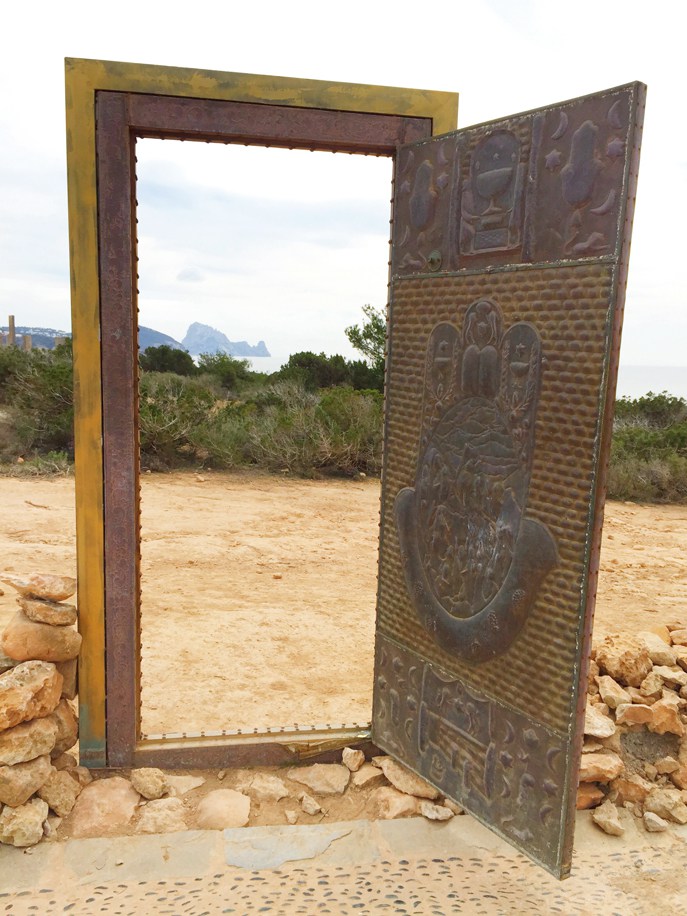
The art installation of Cala Llentia closest to Cala Codolar offers an extraordinary view of Es Vedrà island, which you’re bound to love. These are two doors facing each other and symbolising a small square room (3x3m) in the middle of the countryside. A low stone wall frames the space and a few drawings decorate the floor.
The Doors of Cala Llentia show different Arab engravings and motifs, including a jamsa or Fatima’s hand. This was often found in Muslim and Sephardic-Jewish cultures and used as a charm by the Carthaginians since 820 BC. In the north of Africa it was linked to an attribute of the goddess Tanit, Ibiza’s goddess. From the right angle and with the doors open, you can see Es Vedrà on the horizon. It’s a beautiful image and an attraction for travellers and photographers who turn this place into the perfect frame for their pictures.
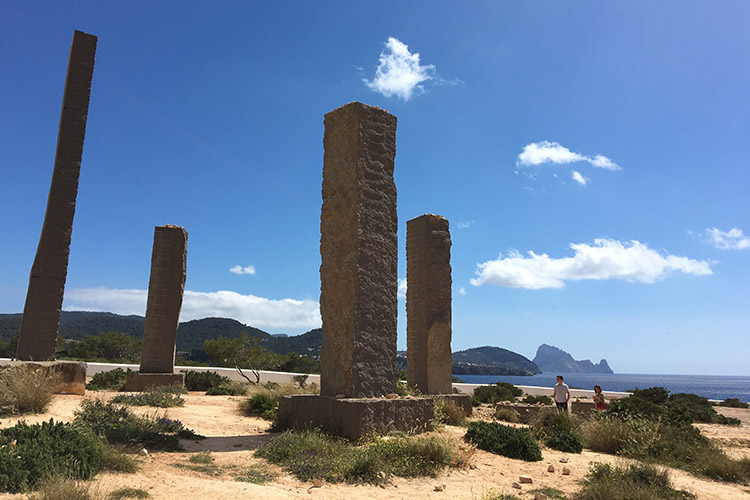 Partial view of the monoliths of Cala Llentia. © NC / Isla Elefanta
What are the monoliths of Cala Llentia?
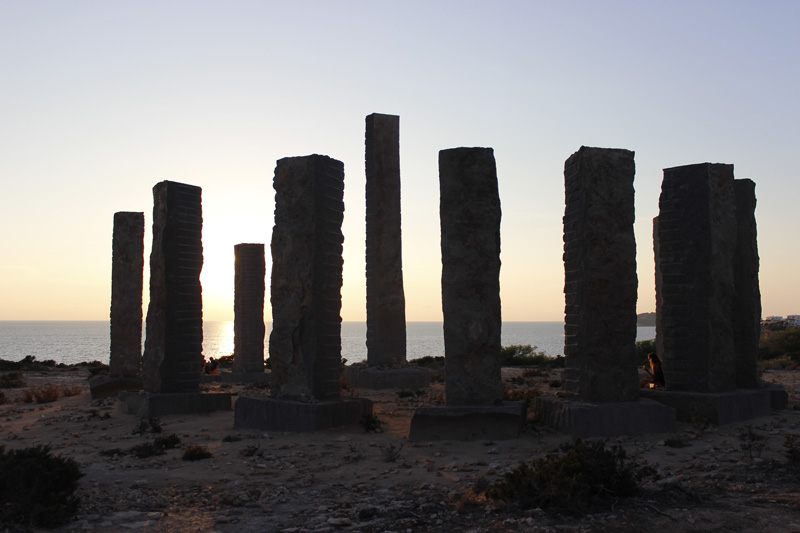
The monoliths of Cala Llentia, also known as the Stonehenge of Ibiza are part of an outdoor art installation called “Time and Space” created by artist Andrew Rodgers in 2014 commissioned by Guy Laliberté, founder of the Cirque du Soleil, who lives nearby. This art installation is made up of 13 basalt columns forming a circle around a central pillar that stands taller than the rest at 20m high and whose peak is bathed in 23 carat gold.
The meaning of “Time and Space”
This composition, which is reminiscent of ancient monuments and seems to recreate a sundial, means to represent, according to its author, Andrew Rogers, the movement of the planets around the sun, aligning the composition with the sunset of the winter solstice. The weight and alignment of each basalt column follows the Fibonacci succession, where each number is the sum of the two previous ones.
Why is Cala Llentia special?
Ibiza has been historically linked to spirituality and alternative cultures and this place embodies that essence to perfection. Erected on an arid stretch of the western coastline only a few metres from the cliff edge, there is nothing but silence, wind and sea. The combination of modern art, nature and views of Es Vedra island creates a spectacular setting for those who seek different places in Ibiza. If you don’t want to miss it, remember a few things that will help you plan your visit to the monoliths and doors of Cala Llentia.
Tips to visit Cala Llentia
There are a few things worth bearing in mind if you're going to Cala Llentia:
- Wear comfortable shoes (the ground is irregular).
- Take water with you and whatever else you need to spend some time there.
- In the summer, avoid the hottest time of the day.
- Respect the environment and the installations.
- Make it a stop on a route along the western coast of Ibiza.
How to get to Cala Llentia
Cala Llentia is on the western coast of Ibiza, near Cala Codolar and Cala Tarida. If you're leaving from Hostal La Torre or San Antonio, you need to head towards San Agustín. Before reaching San Agustín, take the turn to Cala Bassa, Cala Conta and Cala Tarida. Keep heading towards Cala Conta and before you get there, turn left to Cala Codolar. Then you have to drive along a dirt track that ends in an area where you can park your car. Only a few metres on, you’ll see the monoliths, which is the closest installation to where you left the car.
From Sant Antoni and Hostal La Torre: it’s about a 20 minute drive along the scenic route. It’s advisable to use Google Maps and check out the route beforehand.
Best time to visit it
The best time to enjoy Cala Llentia is at sunset. When the sun sets over the Mediterranean Sea, the monoliths cast long shadows and the landscape is dyed in golden hues. It’s one of the most magical places to watch the sunset in Ibiza, without the crowds expected in other better known spots.
First thing in the morning is also a great time if you’re looking for peace and calm, but this place is good any time of the day if you want to relax and get away from the Ibizan summer buzz.
Frequently asked questions about Cala Llentia
- Is it worth visiting Cala Llentia?
Yes, especially if you're interested in unique landscapes, art and peaceful spots in Ibiza.
- Can you swim there?
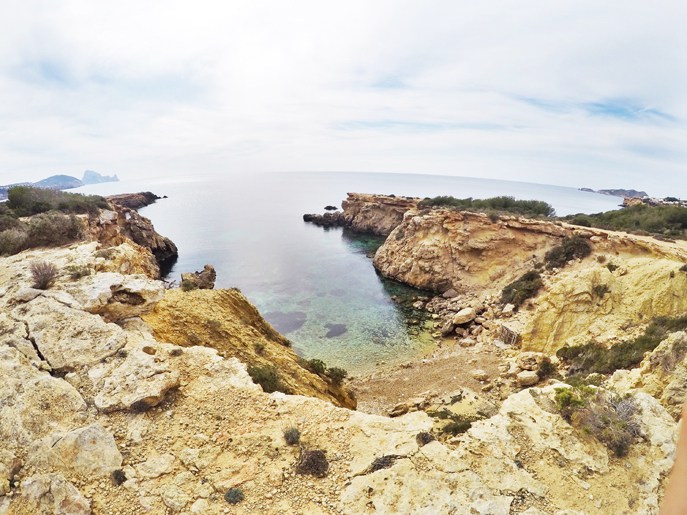
Cala Llentia is a rocky cove, but there are nearby beaches like Cala Codolar, which are more suitable for swimming. Even if the area is called Cala Llentia, there isn’t a proper cove for swimming, only a small fishing spot that is hard to get to. If you want to swim, go to Cala Tarida or, if you have no problems walking over rocks to get to the water, go to Cala Codolar that is next to Cala Llentia.
- Does this place get crowded?
Compared to other places in Ibiza, it’s usually pretty quiet, even in the summer.
Stay near Cala Llentia and the western coast of Ibiza
If you’d like to explore the western coast of Ibiza at a relaxed pace, staying in the area makes all the difference. At Hostal La Torre you’ll be perfectly located to explore places like Cala LLentia and you’ll also get to enjoy at the hotel the best sunsets on the island with DJs mixing Balearic Sound, great food and a unique, cosmopolitan vibe. Book today your room at our boutique hotel on the outskirts of San Antonio and experience a unique stay on a unique spot on a unique island.





 (+34) 971342271
 (+34) 971342271

